
MARJANE SATRAPI
A Tribute

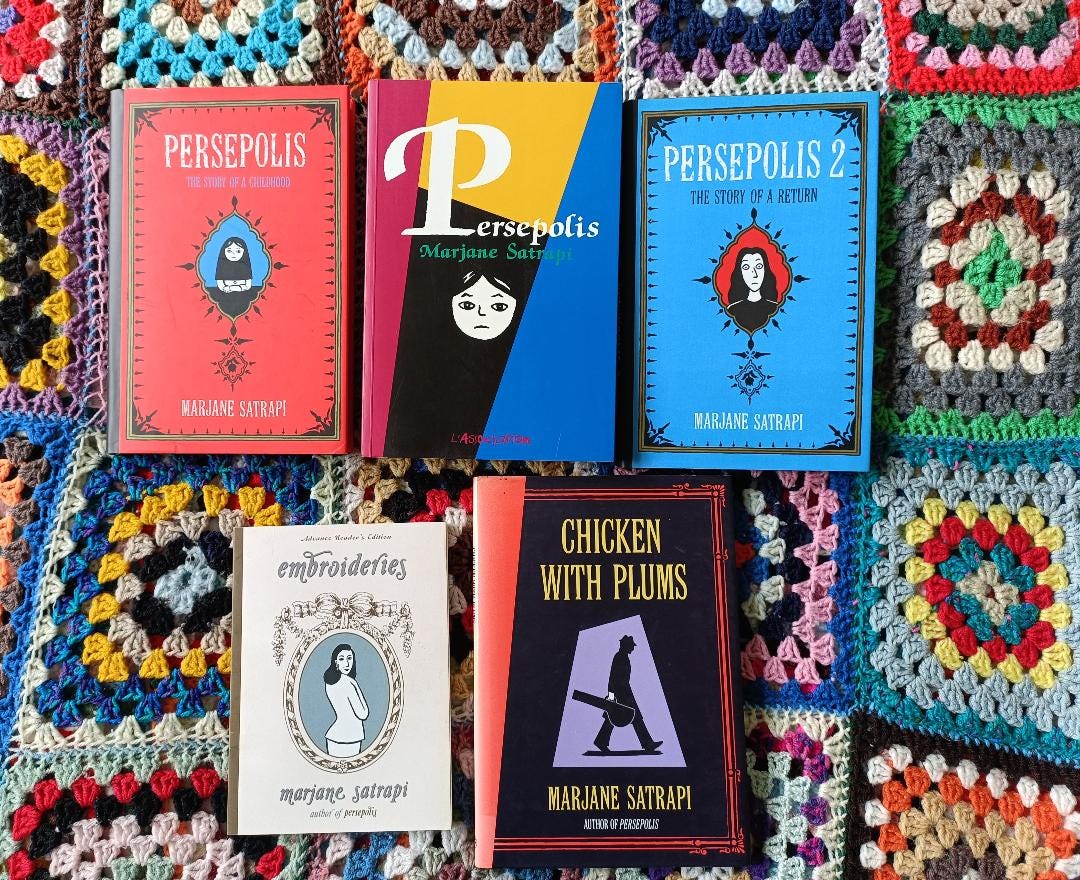
Only the other day I was thinking that I should write something about my abiding love of graphic non-fiction. Then came awful news - that one of the greatest of graphic non-fiction writers and artists, Marjane Satrapi had died at the age of only 56.
I can’t remember when I first read “Persepolis”, Satrapi’s graphic memoir of growing up in Iran during the Islamic Revolution, first published in the UK in 2003. But it feels like I have loved it for ever, and I’ve re-read it several times since. If you have yet to encounter it, then I envy you. In powerful black and white comic strip images, it charts the story of Satrapi’s life in Tehran, from the ages of 6 to 14, years that saw the overthrow of the Shah’s retime, the triumph of the Islamic Revolution, and the devastating effects of the war with Iraq. The intelligent and outspoken only child of committed Marxists, Satrapi bears witness to a childhood that was uniquely entwined with the history of her country. “Persepolis” is both intensely personal and deeply political, and opening it again now feels doubly poignant given the current US-Iran conflict.
Such was my passion for “Persepolis”, I even bought a copy in the original French, and slowly worked my way through it, revising the language I studied at university in the process. When I opened that copy again after hearing of Satrapi’s untimely death, a comic strip cutting by Satrapi fell out - a page I’d clipped from a copy of French Vogue. In it, Satrapi reminisces in words and images about seeing “Belle de Jour” at the cinema in Tehran with her parents. While too young to make sense of the film at the time, she nevertheless took away the idea that its star, Catherine Deneuve was some kind of great mythical figure who didn’t sleep, wash or use the toilet like ordinary mortals. Then one day, years later and living in Paris, she had a call from French Vogue to say that Catherine Deneuve loved her work.
The idea that Deneuve not only loved her work, but also read comic strips was a revelation to Satrapi. She wrote (my translation): “I deduce that since Catherine Deneuve reads comic strips, she also must go to the toilet”.
There is so much subversive humour in Satrapi’s work, but it is also an immensely powerful form of activism. While she latterly worked more often as a film-maker, in 2024, she edited “Woman, Life, Freedom”, a collective book by 17 Iranian and international comic book artists working with Iranian academics and researchers. They came together to chart the story of the death in custody of Mahsa Amini, a 22 year old Kurdish-Iranian woman detailed for allegedly not wearing her headscarf properly. Her death led to widespread popular unrest in Iran. In an interview published when the book came out, Satrapi said “Never forget all the dictatorships are the same. A night before they fall everyone says: they are so solid, it’s impossible they can fall. Then they fall, and everyone asks: how could they have held so long?”
Tragically both the regime and the unrest continues. But the legacy of Marjane Satrapi’s extraordinary work endures too.
The last words of The Complete Persepolis are, "Freedom had a price." Rest in peace. And thanks for this tribute.