
ANALOGUE TENACITY
The Value of Non-Fiction Now

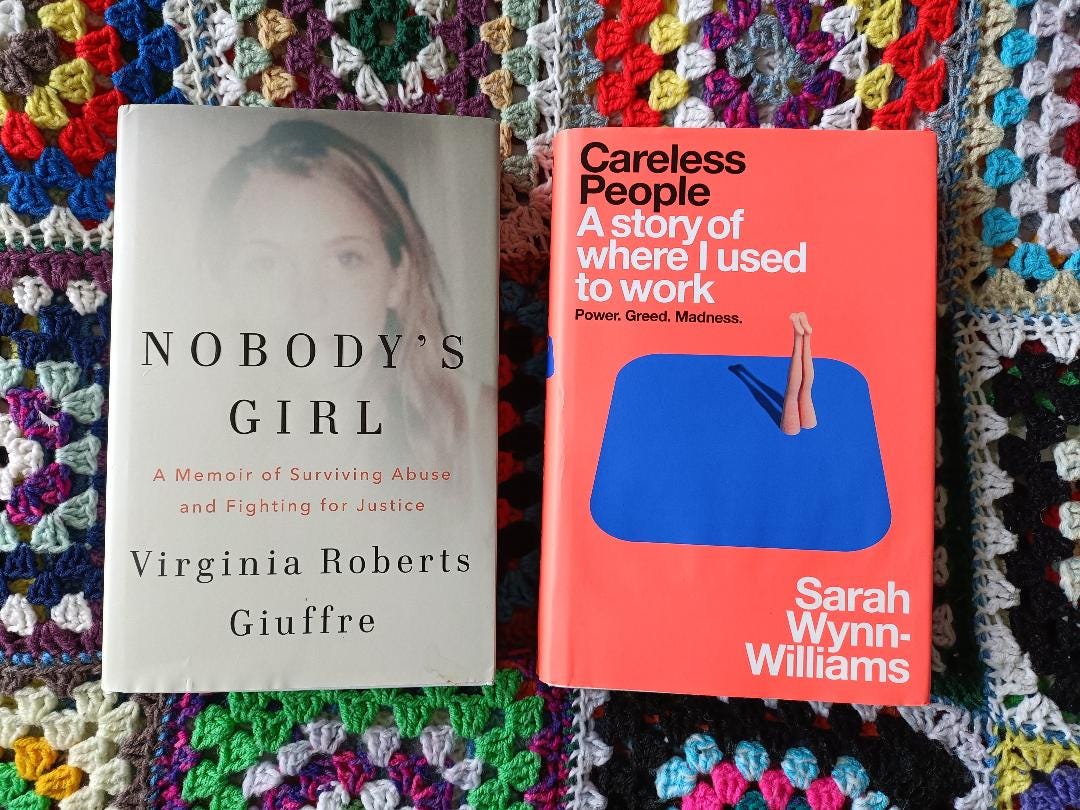
We live in an age where web pages disappear, where a single politically aligned billionaire can spike a news story or delete a viral video. But once a book miraculously makes it out into the world – onto a shelf, into a library, into a home – it cannot be disappeared. With analogue tenacity a book endures.
These are the words of Sarah Wynn-Williams at this year’s British Book Awards which I attended last week. On stage to accept the Freedom to Publish Award, jointly awarded to her book, “Careless People: A Story of Where I Used to Work” and to the late Virginia Roberts Giuffre for “Nobody’s Girl: A Memoir of Surviving Abuse and Fighting for Justice”, Wynn-Williams was prevented from speaking publicly about her own book because of an injunction obtained last year by Meta, the parent company of Facebook, whose greed and power-driven machinations she exposes so vividly within it. In fact ahead of the event, The Bookseller which organises the awards was asked to blur any displayed images of her book’s cover, because in a hardening of the original order, she is now unable to even be seen in the presence of her book.
So instead Wynn Williams did something remarkable. She chose to speak about a different book and author; about “Nobody’s Girl” by Virginia Roberts Giuffre. And in doing so, she articulated brilliantly why non-fiction books like hers, like Virginia’s, are so important right now. Because they speak truth to power.
Be in no doubt, Wynn-Williams emphasised, that such books can also cost everything to write. Virginia Roberts Giuffre spent years exhausted by a battle she should never have had to fight and did not get the ending her story deserves. And yet, she added, “there is something the powerful have never been able to destroy. Not princes, not presidents, not lawyers, not the grinding machinery of institutional silence. The power of a book”.
She continued: “This is what the greatest acts of witness always do. They do not close a story. They open it outward – into all the other stories that were never told, all the voices that were silenced before they found a page”.
Sarah Wynn-Williams’ speech was the most rousing rallying cry for the crucial importance of physical books I have heard in a long time. And yet, with a few exceptions, sales of serious Non-Fiction books are dwindling right now. I am under no illusion that the typical book buyer always wants to spend their hard-earned cash on books about difficult issues that can be hard to read. Or indeed spend their valuable, concentrated time on them, particularly with the proliferation of podcasts you can listen to while doing other things.
But without the Non-Fiction books that voice the things we’d rather not know, but urgently need to, the world would be an even more deeply worrying place. As one reader of a Substack post of mine commented a few weeks ago, “Non-Fiction books matter more than ever in today’s splintering world”.
They matter not only because of the issues they force a reckoning with, but because of the voices they enable to be heard. Victoria Roberts’ Giuffre’s voice. Alexei Navalny’s. Gisèle Pelicot’s. Those names are now globally known, but Non-Fiction books also resound with lesser-known but nevertheless significant voices, testifying to some of the most pressing issues of our times. To mention a few recently published examples: “The Lifeboat at the End of the World” by volunteer lifeboat crew member Dominic Gregory which brings home the horror of the so-called “small boats crisis” in the English Channel; “Rough Edges: Where Land Meets Water, The Untold Stories of Coastline Communities” by working-class advocate Natasha Carthew; and “My Body is a Meadow: Finding Freedom in the Outdoors” by Bethany Handley which is about ableism, climate justice and access to nature for all of us.
And in “This is Also a Love Story: Searching for Good in a Divided World”, Orwell-Prize winning author and journalist Sally Hayden tells human stories from behind the headlines of the world’s most turbulent places, stories which remind us of the courage and altruism that can still prevail amid a ton of pain and suffering. In her Prologue Hayden writes: “Journalism is the first draft of history, but it only offers fragments of a wider truth. What can go missing in that initial retelling is a much fuller tapestry of human behaviour, interactions and the connections that drive them”. A stellar argument for Non-Fiction books right there.
Monday night’s British Book Awards made me proud to be part of the book industry. Although I wish I could engender better Non-Fiction sales by advocacy alone, I realised we can’t not have these books. In courageously and meticulously reckoning with the stories that truly need to be told, they have more than proved their immense value to us all.
'we can’t not have these books'. Well said (as ever) Caroline